Foals & Raising
Growing Up with Trust
„We don’t breed show horses. We raise partners for life.“
— Sandra Müller
The First Step of a Long Journey
A horse’s journey doesn’t begin the first time it carries a saddle. It begins much earlier — on the pasture, in the herd, among people, other horses, in motion, in all weather, in everyday life, and in rest and recovery.
That’s why we take our time with our foals. They should be allowed to grow at their own pace, become openly curious, build trust, and learn step by step that the world doesn’t need to be loud to be exciting.
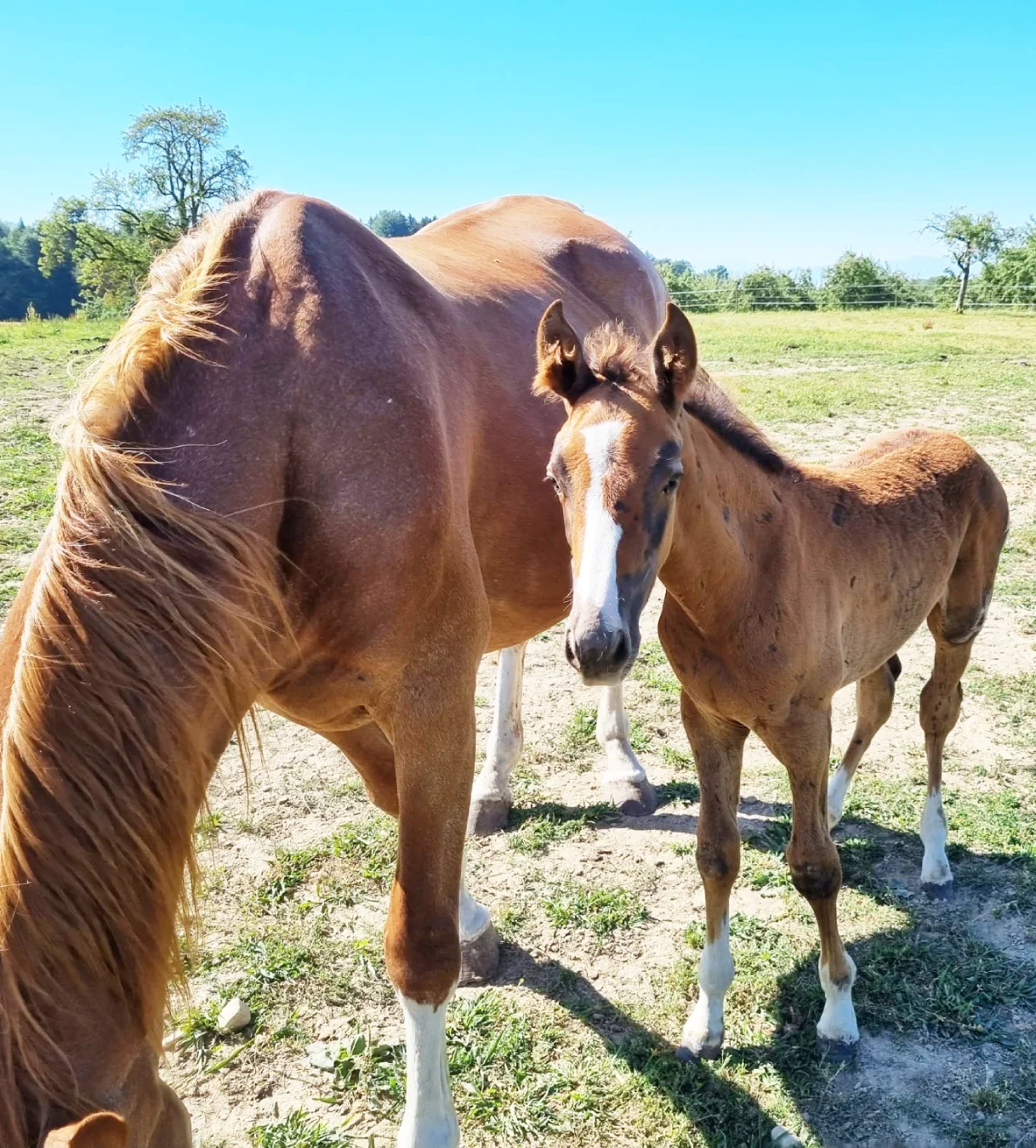
How a Horse Truly Becomes What It Is
A horse later reflects what was lived and upheld during its upbringing.
Not as the result of a programme — but as the result of time, observation and genuine care.
We’ve defined nine principles that guide how our foals grow up. Not a checklist. A part of how we live.
„A good horse doesn’t begin with training. It begins with trust.“
— Sandra Müller
1 — Time
The most important principle that can’t be rushed
We live in a world that wants to see results fast. Young horses have heard about that — and couldn’t care less.
A foal coming into the world needs one thing first: the chance to simply be a foal, undisturbed. Nothing more. In its first months, it learns through observation, through play, through closeness to its mother and the herd. It processes impressions. It tests boundaries. It sleeps. It runs. It just stands in the sun.
That sounds modest — and yet it’s the foundation for everything that follows.
Body and mind don’t mature at the same pace. Bones, joints and tendons need years to become resilient. Anyone who puts a young horse to work too early risks more than physical damage — they also rob the animal of the experiences it needs to develop a stable character.
With us, there’s no rush. Our foals grow up until they’re ready. Not until we are.
2 — SAFETY
Safety — what a young horse needs to feel at home
Safety isn’t a coincidence. It comes from reliability.
For a young horse, safety means that what was true yesterday is still true today. That the people caring for it are calm and predictable. That its surroundings don’t constantly shift, and that change is introduced gently.
A good herd matters just as much as a good stable — maybe even more. Horses that grow up in a stable group tend to show more calmness later in life, because they’ve learned that the world is orderly. That there are rules. That others can be relied on.
Safety doesn’t mean silence. Our farm is full of life: children run across the yard, dogs lie in the way, the tractor starts up, visitors arrive. But all of it happens within a framework that’s reliable. And that’s where the real difference lies — not in the absence of stimuli, but in the presence of orientation.
A young horse that feels safe dares more. It’s more curious, more open, and learns more easily — because it doesn’t have to spend its energy protecting itself.
3 — EVERYDAY LIFE
The real thing is the best preparation
There are horses that function perfectly in a quiet, controlled environment — and fall completely out of balance the moment the world gets a little louder, more colourful, or less predictable.
That’s rarely about the horse. It’s about what it has learned.
Our foals grow up right in the middle of everyday life. Not alongside it — inside it. Children who shout and laugh. Dogs that bark and sniff around. Machines starting up. Strangers passing through. Rain, wind, summer, winter. All of it is normal — because it was normal from the very beginning.
This isn’t a method. It’s simply our farm.
What this creates is a kind of natural ease. A horse that already knows everyday life doesn’t have to figure it out later. It has learned to make sense of the world without becoming nervous. It doesn’t ask “What is that?” — it thinks “I know this. No big deal.”
This inner calm isn’t a trait you train. It’s an experience you gather. And the earlier, the better.
4 — TRUST
The one thing that truly holds
Trust can’t be demanded. It can’t be rushed. And it can’t be replaced — not through dominance, not through pressure, not through repetition without understanding.
Trust grows in small moments. When a foal approaches something new and realises: I won’t be overwhelmed here. When it stumbles and realises: nobody makes a big deal out of it. When it tests boundaries and realises: the people here are consistent, not unpredictable.
Trust grows from many such moments — over months, over years. It’s the result of a young horse repeatedly experiencing that encounters with people end well. Not dramatically. Not spectacularly. Just well.
We believe trust is the foundation for everything that follows. Not as a sentimental idea — but in a very practical sense: a horse that trusts learns more easily. It stays calmer in new situations. It cooperates, because it knows cooperation pays off.
This isn’t a trick. It’s a relationship you earn.
5 — CHARACTER
Character that grows through play
A horse with healthy self-confidence isn’t a difficult horse. It’s a complete one.
Assertiveness might sound like stubbornness or dominance — but what’s meant here is something different: a young horse’s ability to hold its own within the group. To find its own place. To not lose itself when others try to take charge. And still know when to yield.
No horse learns that through training. It learns it through the herd.
In a well-balanced group, there are countless small interactions every day: Who gets to drink first? Who steps aside? Who holds their ground when it comes to the best hay? These moments aren’t conflicts — they’re lessons. Social lessons that shape patience, endurance and a clear sense of will.
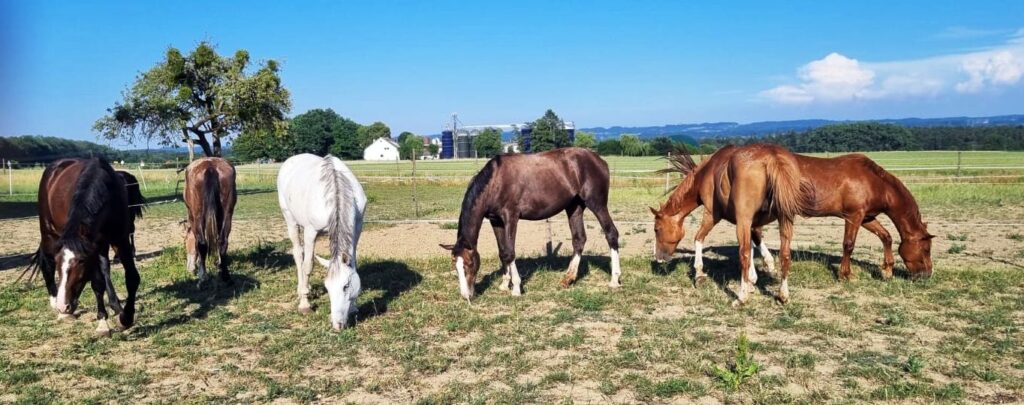
A young horse raised within a group knows how to behave. It understands rules, hierarchies, closeness and distance. It is resilient. And it brings exactly what matters later in working with people: steadiness and a willingness to cooperate, in equal measure.
6 — MOVEMENT
Not performance — rather enthusiasm, development
A foal galloping across the pasture is training itself. Not because someone’s guiding it — but because its body needs it.
In raising a horse, movement isn’t a bonus. It’s a requirement. Bones grow stronger through load. Tendons and ligaments need varied ground, slopes, different surfaces. Joints develop through varied movement — not through uniform walking on flat terrain.
That’s the major difference between pasture and stable: on the pasture, the horse decides for itself how it moves. It runs when it feels like it. It stops when it’s time. It romps, plays, explores — all in its own rhythm.
No training session in the world can replace that.
We give our young horses enough space and time for free movement every single day. No task. No expectation. That’s not generosity — that’s responsibility.
7 — HERD
What no human can teach alone
Horses are herd animals. Not as a romantic description — but as a biological fact. Their entire social behaviour, their body language system, the way they process stress and find safety: all of it is built around life within a group.
A young horse that grows up without a herd is missing something. Not something nice to have — something fundamental.
Within the herd, a foal learns to read the body language of other horses. It learns when another animal signals its limits — and how to respond. It learns how hierarchies form and shift. It learns patience, because sometimes it has to wait. And it learns trust, because it can rely on others.
Older horses within the group are especially valuable here. They set boundaries — calmly, clearly, consistently. They show the young horse how an orderly community works. That’s education — entirely without human help.
What’s learned in the herd runs deep. And it shows later: in calmness, in willingness to cooperate, in how the horse handles unfamiliar situations.
8 — HEALTH
Daily attention, not a one-time action
Health shows itself in small things. In a coat that shines or looks dull. In eyes that are alert or tired. In the way a horse stands, eats, moves within the herd. In details you only notice if you look every single day.
That’s exactly why regular observation is so important in raising a horse. Not one big check-up once a year — but daily attention, honest assessment, and early action when something’s off.
Good raising includes the right foundations: regular vaccinations, veterinary check-ups, hoof care at reliable intervals, dental checks and parasite management based on need — not on a calendar. Young horses are more vulnerable than fully grown ones. Their immune system is still developing, and their bodies react more sensitively to parasites, deficiencies and strain.
Good raising doesn’t save on vet visits. It saves on problems down the line.
Documentation matters to us too: equine passport, vaccination records, veterinary findings — everything that belongs to a horse and should remain traceable later on.
9 — NUTRITION
Not a lot — just the right amount
A young horse doesn’t eat like an adult one. It grows. And growth is more demanding than most people think.
The biggest mistake in feeding young horses isn’t deficiency — it’s overfeeding. Too much energy, too much protein, too rapid growth. What looks like care can actually harm the body: bones and joints grow under pressure and become more vulnerable. Sometimes that only becomes apparent years later.
A healthy young horse should be well developed — but not excessively muscled. It should grow slowly and evenly, not in spurts that strain the musculoskeletal system.
The foundation is always roughage: good hay, pasture time, clean water. Minerals and trace elements make up for what the meadow and hay can’t provide — especially crucial during the growth phase, since bones, joints and muscles depend on them.
Concentrated feed isn’t standard. If used at all, it’s given sparingly, purposefully, and matched to actual need — based on age, development, season and pasture quality.
We observe our young horses daily: coat, weight, muscle tone, droppings, energy levels. Not because we worry — but because that’s the only way to notice in time whether something needs adjusting.
These nine principles aren’t the result of a textbook. They’re what we’ve come to recognise as right over time — through observation, through mistakes, through horses who taught us something. We don’t claim to have it all figured out. But we stand behind what’s written here.
If you’d like to know more about how our foals grow up — get in touch. We’ll answer honestly.
Frequently Asked Questions — Before Interest Becomes Responsibility
We’re happy to answer questions directly, so don’t hesitate to reach out!